Custom vs platform · Website security

Why we don’t build websites on WordPress.

What your website runs on matters more than most businesses realize. Two critical PHP vulnerabilities made public in October 2026 show why we custom-code our websites instead of building them on WordPress and other third-party platforms.

3 min read 5-slide carousel
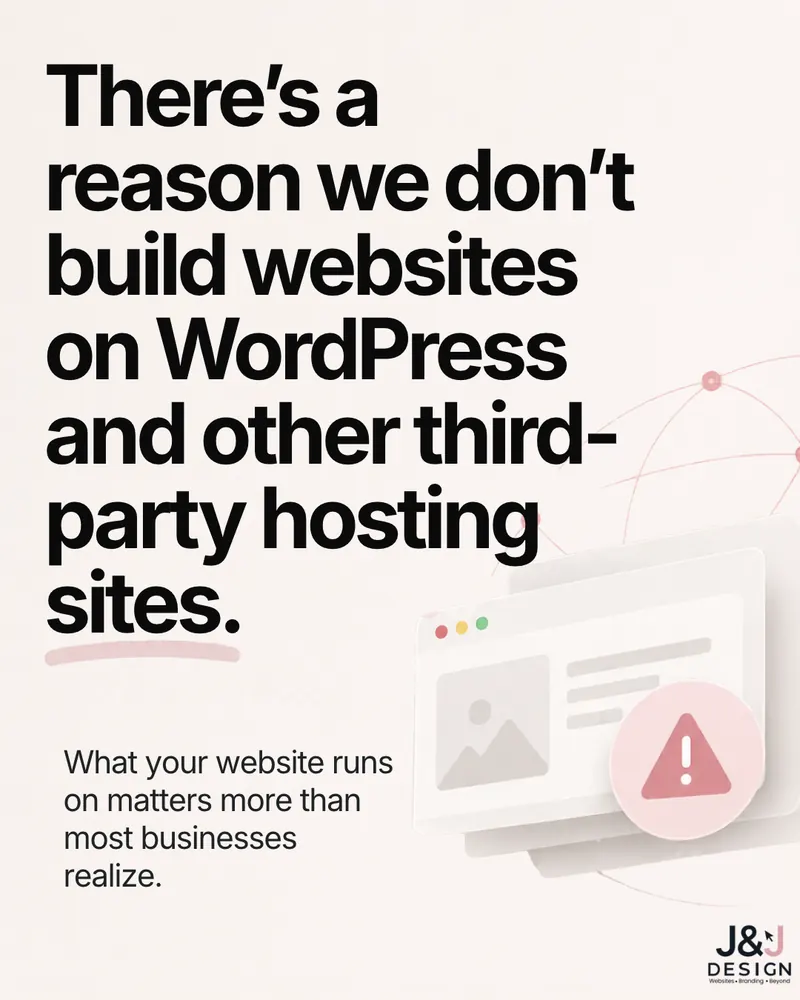
Carousel cover: There's a reason we don't build websites on WordPress and other third-party hosting sites. What your website runs on matters more than most businesses realize.

If your website runs on WordPress, it runs on PHP. In October 2026 two critical vulnerabilities in PHP were made public, and they are a good reason to ask what your own website is built on.

This carousel from our Instagram explains why we don’t build websites on WordPress and other third-party platforms. Below, we go through it slide by slide.

Carousel cover: There's a reason we don't build websites on WordPress and other third-party hosting sites. What your website runs on matters more than most businesses realize.
Slide 1 of 5

What your website runs on matters

There is a reason we don’t build websites on WordPress and other third-party hosting sites. Many business owners never see what sits underneath their website, and what it runs on matters more than most businesses realize.

Slide: Your website isn't just a pretty homepage. It's your business's digital storefront, and the technology behind it matters just as much as the design. A shopfront with a striped awning and an Open sign, labelled Design and Technology.
Slide 2 of 5

More than a pretty homepage

Your website isn’t just a pretty homepage. It is your business’s digital storefront, and the technology behind it matters just as much as the design.

Visitors see the design. The technology is the part they never see, and it is the part that has to keep working long after launch day.

Design is what people see. Technology is what keeps the doors open.

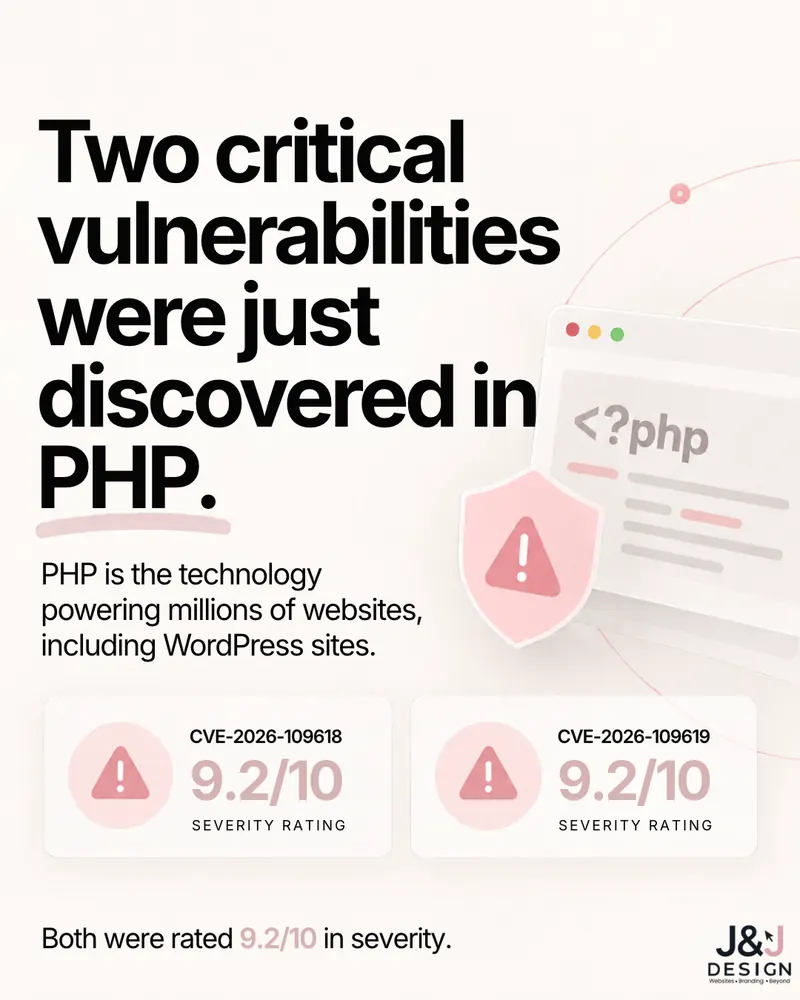
Slide: Two critical vulnerabilities were just discovered in PHP. PHP is the technology powering millions of websites, including WordPress sites. CVE-2026-109618 and CVE-2026-109619, each with a 9.2/10 severity rating. Both were rated 9.2/10 in severity.
Slide 3 of 5

Two critical flaws in PHP

PHP is the technology powering millions of websites, including WordPress sites. On October 21, 2026, PHP’s security team published two critical vulnerabilities, CVE-2026-109618 and CVE-2026-109619, and rated both 9.2 out of 10 on the CVSS 4.0 scale.

Both are flaws in how PHP handles memory between one visitor’s request and the next. The National Vulnerability Database describes each one as able to lead to remote code execution, meaning that under the right conditions an attacker could run their own code on the server behind a website.

Whether a particular site is exposed depends on the PHP version it runs and how it is kept up to date.

Two flaws, both 9.2 out of 10, in the technology WordPress sites run on.
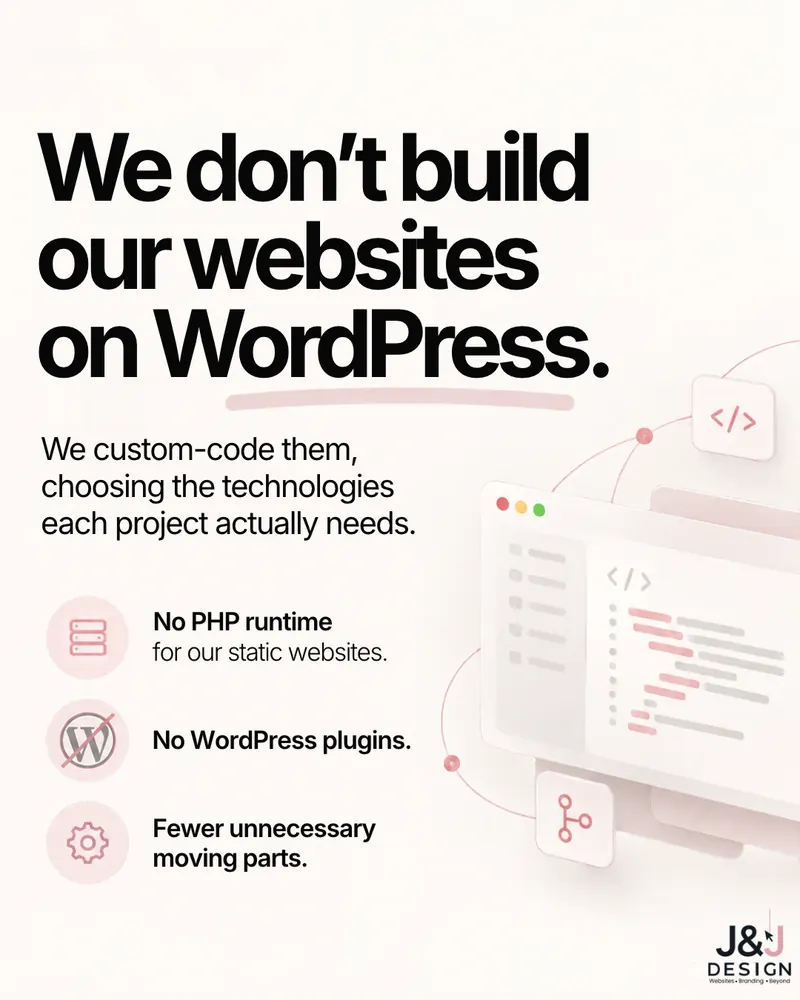
Slide: We don't build our websites on WordPress. We custom-code them, choosing the technologies each project actually needs. No PHP runtime for our static websites. No WordPress plugins. Fewer unnecessary moving parts.
Slide 4 of 5

Custom-coded, with fewer moving parts

We don’t build our websites on WordPress. We custom-code them, choosing the technologies each project actually needs. For our static websites, that means:

  • No PHP runtime, so PHP flaws like these two do not apply to them.
  • No WordPress plugins to keep patched.
  • Fewer unnecessary moving parts, so there is less to maintain and less to go wrong.

It is the same thinking behind our custom website vs Wix breakdown: no third-party platform in the middle, and website files you own.

Slide: Questions or concerns about your current website? Reach out to us. If you are unsure what your website is built on, or you have concerns about PHP, WordPress, or third party platform risks, send us a message.
Slide 5 of 5

Not sure what your site runs on?

If you are unsure what your website is built on, or you have concerns about PHP, WordPress or third-party platform risks, send us a message. We will tell you what it is built on and what we would change, in plain language.

Already on WordPress? Start with two questions.

Ask whoever looks after your website which version of PHP it runs, and when it and its plugins were last updated. If nobody can answer, that tells you something. When you are ready to compare the options, our guide to what website builders really cost lines the platforms up side by side.

The short version

What it comes down to, in three lines.

  1. The platform is part of the risk. WordPress runs on PHP, so a PHP flaw is a WordPress site’s problem too.
  2. Two critical PHP flaws, 9.2 out of 10. CVE-2026-109618 and CVE-2026-109619, published October 21, 2026.
  3. Fewer moving parts, less to patch. Our static websites have no PHP runtime and no plugins.

Share this article

  • Facebook
  • LinkedIn
  • https://www.jandj-design.ca/why-we-dont-build-on-wordpress

Keep reading

More straight talk from our feed.

Unsure what your site runs on?

Ask us about your website.

Send us your address and we will tell you what it is built on and what we would change, in plain language. The first conversation is free.